4 Great Ways to Leverage User-Generated Content

Great user-generated content (UGC) should not exist in a vacuum—it should be reused, when and where appropriate, to bring color and authenticity to a brand’s marketing.

As brands expand their social-media footprints, many have also (smartly) placed more emphasis on engaging with their fans. As a result, they’ve begun proudly featuring selected consumer contributions in print, TV and online advertising. Dedicated fans often create a gold mine of content that’s just waiting to be explored, and in due course, brands have begun to dip into this resource. It’s the easiest and most direct way to build relationships with customers, because their passion for their favorite brands makes them happy to respond and share their stories—messages that are infinitely more compelling than what the brand might say.

Here are some great ways to use freely made consumer-generated content from social channels to great effect.

Share

Food Truck Culture: Is There Room for National Chains?

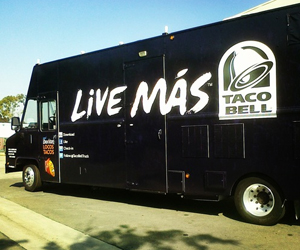
Food truck fanatics, hold on to your tongues: Fast-food giants from Sizzler to Taco Bell to Jack in the Box to Applebee’s have fully functional food trucks parading down streets across America. Some just hope to capitalize on the current food truck trend, while others predate it. Should supporters of what some might call authentic food truck culture—the kind incubated in Portland, Oregon; Los Angeles; and other cities—be worried about these flirtations by the big-timers they already vie with every lunch hour?

An increasing number of quick-service restaurants are looking at the medium as more than just an agile promotional vehicle for products and locations—a view that could spell trouble for independents. 

But, instead of being considered a threat to the carefully cultivated culture’s longevity, could the increased presence of national brands (as documented by AdWeek) just be a harmless, but telling, aftereffect of a new marketing approach’s success?

One thing’s for sure: The wild success of certain food trucks is no fluke; it’s in no small part due to a breaking from the marketing conventions of larger chains in favor of a nimble, post-ad-approved approach. Mobile or brick-and-mortar, there’s plenty for businesses small and large to learn.

Share

Is Tumblr Doomed?

Tumblr is doing things differently. While Facebook and Twitter constantly load up on new features—many of which premiere to groans from avid users—Tumblr is scaling down and making things simpler in order to foster a positive artistic community. Tumblr also stands out by refusing to employ traditional digital-advertising methods. With more than 64 million blogs and 15 billion monthly page views, Tumblr could easily make millions through display, banner or video ads. But founder David Karp is sticking to his guns and rejecting anything he deems counter-creative. Instead he is focusing on a more holistic, integrated form of advertising wherein the brands involved must create great content on Tumblr. But given that the platform hosts edgy content (most recently, the disturbing “Holmies" sect) and is still largely pigeonholed as a place for fanatics and fanatical sharers, is this just wishful thinking? 

Share

7 Reasons Storytelling Is Important for Branded Content

Gutenberg invented the printing press around 1440. 
The first radio transmissions were in the early 1900s.
The television became commercially available less than a century ago. 
The Internet is not even old enough to have a drink (legally; at least not in the United States).
Facebook and Twitter are just out of diapers, and the next big marketing tool is still in the womb or possibly just a twinkle in its creator’s eye. 

When most people think about marketing, these are the tools they think of: print, radio, TV and the web. None of these, however, are ingrained in us as much as storytelling. We’ve been telling stories for thousands of years, but we don’t have to go back that far to understand storytelling’s powerful effect on our hearts and minds. Go back only as far as your childhood, when you begged your parents to read your favorite story—the one you already knew by heart—just one more time. Why did you do that? Why was it so important to hear that story?

Share

Is Foursquare Becoming the Perfect Local Ad Platform?

Local merchants that’ve ignored location-based check-in platform foursquare have just been handed a serious reason to get on board: Local Updates, the first-ever way for merchants large and small (all one million of them, currently) to communicate directly with their customers on the platform, has arrived. As of today, they’ve even begun testing the waters with Promoted Updates, a way for a business to attract new customers through paid placement (the difference: spots, matched relative to interests and activity, are only seen when you’re actively searching on the Explore tab). This, coming a month into foursquare’s strategic shift in approach—including a rebuilt mobile app (try it out if you’ve written FS off)—means that the newfound focus for the platform as a social-exploration tool is as much about enabling richer user-to-user interactions as about enabling richer business-to-customer and customer-to-business interactions.

Share

Microsoft’s “Brandon Generator” is Close, but No Cigar

Post-advertising is based on brands genuinely adding value to consumers’ lives by generously giving them valuable content. By providing rewarding experiences, brands earn the right to expose consumers to their products and services. At its core, post-advertising is about creating an audience around relevant content and then migrating that audience to relevant products and services.

Microsoft’s crowd-sourced, animated graphic novel, Brandon Generator, a stylish, Sin City type animation in which the audience helps shape the protagonist’s world, would seem to meet this definition.

Share

What’s the Point of Paid Media in Post-Advertising?

Paid, earned and owned media are integral parts of any brand’s media strategy. While owned and earned media have flourished during the evolution of the marketing and advertising landscape in the past two decades, paid media has had a tumultuous ride. It has been the catalyst (broadly speaking) for obnoxious and interruptive advertising—pre-roll ads, billboards, banner ads; the kind of advertising we love to point out and lambaste—which makes it an easy target for ridicule by marketers trying to sell owned- and earned-media strategies into brands. But is it fair to ship paid media off to the Island of Misfit Toys? Is it a big mistake to ignore an effective paid-media strategy?

Share

Why Celebrity Ads Fail

According to a new infographic from Crowdtap, “consumers trust recommendations from peers over all other forms of advertising.”

That’s right. Earned media—a suggestion from his neighbor, his college buddy or even his dentist’s cousin—will influence Mr. Consumer more than  a high-budget television, print or online banner ad. This is echoed by another recent study, this one by Nielsen, which also found that consumers trust online opinions (read: those of complete strangers) more than they trust any other form of editorial content, ads or sponsorships (and second only to recommendations from people they know). The full results below:

Share

What a Lemonade Stand Taught Me About Storytelling

I was on my way to play golf this past weekend when I drove by a young girl selling lemonade on the sidewalk in front of her house. I have always made a point of stopping and purchasing (insert product here) if a child is selling it (not their parents—the child). Unfortunately, I was running late, and this time I couldn’t stop. It broke my heart.

I pass a convenience store on the same route to the highway, and I don’t even think about stopping there for lemonade, even though the ones they sell probably taste just as good and haven’t been sitting outside in the hot sun. I don't stop at the lemonade stand because I am craving lemonade. I stop because there’s a story behind the lemonade stand. I may not know the details, but I know it’s there, and I have an idea of what it might be. When I get home, I can mention to my wife that I stopped at a lemonade stand and tell her all the cute things the child did as she made the sale.

Share

Dish Network’s Hopper Fights the Future of Traditional Advertising

The commercials for Dish Network’s ad-skipping DVR, the Hopper, are quite memorable and humorous to a native of Massachusetts, like me. The actors have thick Boston accents, and they repeatedly pronounce the name of the device the way any good Red Sox fan would: “Hop-ah.”

It’s ironic, though, that the Hopper’s commercials are so memorable. The device’s primary function is to eliminate commercials altogether. The Hopper automatically records the entire prime-time lineups for ABC, CBS, Fox and NBC. With a little user programming, however, many digital video recorders (DVRs) can do that. What sets the Hopper apart is that it enables playback completely sans commercials (versus fast-forwarding over them). Score another point for ad-slaying technology in the post-advertising age.

Share