

Why Storytelling is the Best Way to Engage Health Care Audiences
Additional reporting by Nick Dutnall.
Relying on numbers at the expense of human judgment and experience, no matter how reassuringly extensive the latter, can lead to poor decision making that has far-reaching consequences (see our recent post on the limitations of “big data”).
Why You Should Stop Worrying About Big Data and Love Your Consumer
In the post-advertising world, many brands struggle to understand the people they’re selling to and why they behave as they do. As power shifts from brands to consumers, knowing your consumer has never been more important. Even the accounting firm PwC has woken up to the fact that “every industry participant will need to invest in customer understanding and engagement.” But so long as this point is couched solely in data-analytics terms, it tells only part of the story.

“Boris” Bikes and Barclays’ Problem with Authority
London’s rammed with bicycles. Everyone’s on two wheels. It’s fun, cheap, and good for you. Barclays-branded hire bikes are everywhere. But no one thinks of the sponsor when they pick up their wheels: instead, everyone calls them Boris Bikes, after our haystack-haired mayor, Boris Johnson. Why? Because Barclays is, uh, a bank with no authority in pedal power, unlike our nutty figurehead, a cycle-clipped champion of the joy of spokes.

For Second Screen Engagement, Twitter Leads the Pack
Last fall my favorite TV show was American Horror Story. I enjoyed all the twists and turns, but more than that, I loved getting together online with friends and perfect strangers every Wednesday night to see how each episode would unfold and talk about predictions for the rest of the series.
More and more, people are turning to their laptops and mobile devices as a way to virtually gather ’round the TV set and share an entertainment experience. But for brands deciding where to invest their engagement efforts, there are a multitude of options to consider.

5 Social Media Tips to Ignore
Do a quick Google search or scour the front pages of your favorite social media blogs and you’ll find a seemingly endless array of articles providing you with tips and advice on social media (this blog included). But if you read enough of them, which I do, eventually you’ll see those tips and bits of advice contradict each other.
Don’t post on Facebook more than once a day, or your fans will un-Like you.
Post more than once a day on Facebook to keep your People Talking About This score high.
Photos are the most shareable content on Facebook.
Videos are the most shareable content on Facebook.
Post on weekends because other brands don’t and you’ll stand out.
Don’t post on weekends, because nobody is listening then.
It can become dizzying. It’s not that your favorite social media pundit is lying to you or flat-out wrong. Truthfully, not everyone can be right; but there are certainly areas of gray, and depending on your brand and audience, advice can differ.
But I have heard a few tips that are just flat-out wrong or at least shouldn’t be followed as if they were gospel. Here are five social media tips you may want to ignore, but you didn’t hear that from me.
What Billions of Cicadas Taught Me About Storytelling
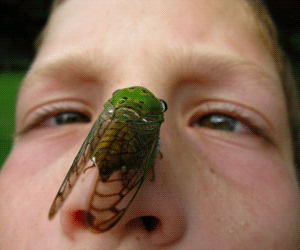
The cicadas are coming. Billions of buzzing (relatively harmless) insects will descend upon the eastern United States from Georgia to New England in the coming weeks.
If you’re not familiar with them, cicadas are a unique species. For most of their lives, cicadas live underground as nymphs, digging and feeding on roots. After 17 years underground, in the last few months of their lives, they emerge by the billions, seeking high ground (mostly in trees) on which to shed their exoskeletons and emerge as beautiful winged insects. They mate, the females give birth to new nymphs deep within tree branches, and then they die. While their life cycle is unique, cicadas are most commonly known for their mating song, which is sung by the males and is among the loudest of all insect-produced sounds.
Most people are dreading their arrival. Imagine a fly: Now significantly multiply its size and sound and you’ve got a cicada. Oh, and imagine not one single cicada but billions. Plus, when their life cycle is complete, their carcasses will litter the ground. Are you excited yet? I’m going to ask my wife if she’s excited and will check back with you in a minute. Spoiler alert: She’s not excited.
Until recently I shared her sentiments. That is, until a short film by Samuel Orr about cicadas completely changed my perspective, and taught me a lesson about storytelling in the process.

Not Everyone is a Storyteller
Lately, everyone in advertising has become a “storyteller” specializing in "engaging content."
This isn’t true, of course. But I understand why everyone’s making the claim: Digital is the only part of advertising that’s growing rapidly; social media is the red-hot center of digital; to make social work, you need conversation-starting (and sustaining) content.

Baking Brand Storytelling Into Your Lunch
Any restaurant is rich in stories, from the founding of the establishment to the experiences of its patrons. Because of that, the restaurant business is an interesting venue for content marketing, social media and brand storytelling.
I like to think that the best part about going out to eat, particularly with friends, isn’t the food (though don’t get me wrong; I adore food). It’s the stories we share and the stories we create. It’s like the times spent with my wife reviewing our plate of nachos in hopes that someday we’ll cull all those reviews into a blog just about nachos (though that’s a whole other story). It’s the times spent with friends catching up and reminiscing about old times.
Restaurants have a unique opportunity to tap into brand storytelling, and there’s a restaurant in the U.K. doing just that.
3 Television Shows that “Get” Social
Television has been “social” for years now, but the rapid embrace of real-time marketing in 2013 (and we’re only two months into it) has shifted social TV into a higher gear.
But the topic of brands reacting to television programming via social channels has been discussed ad nauseam. I’m not sure anyone can write an article lately about social media without mentioning Oreo, and this year’s Oscars apparently invited every brand to the social media party, whether it was relevant or not.
What is largely forgotten in all this is the shows themselves. Social media is fertile ground for television programs to engage audiences not only before, during and after an episode airs, but also during the off-season, making social a year-round commitment. Now that countless brands utilize real-time second-screen tactics, it’s time to investigate which shows and channels are innovating in the social space.